
A 1929 campaign taught the world how to sell without telling the truth. The lesson stuck. Here is what it means for the businesses you run today.
Maple Dappa · Founder & CEO, Mapemond Limited · September 2026
On Easter Sunday, 1929, a group of women marched down Fifth Avenue in New York City, each one holding a lit cigarette above her head. Photographers were there. Reporters were there. By the following morning, newspapers across the country had called it a spontaneous act of feminist defiance. None of it was spontaneous. Every photograph, every story, every woman standing in that line had been arranged by a single man with a single client and a very specific objective.
The Architect
His name was Edward Bernays. He was the nephew of Sigmund Freud — which either explains everything or is the most dramatic coincidence in the history of marketing. By 1929, he had already run public opinion campaigns for the United States government during the First World War. He had since moved into private consulting, built around a clear thesis: if you understand what people fear, desire, or wish to become, you can move them.
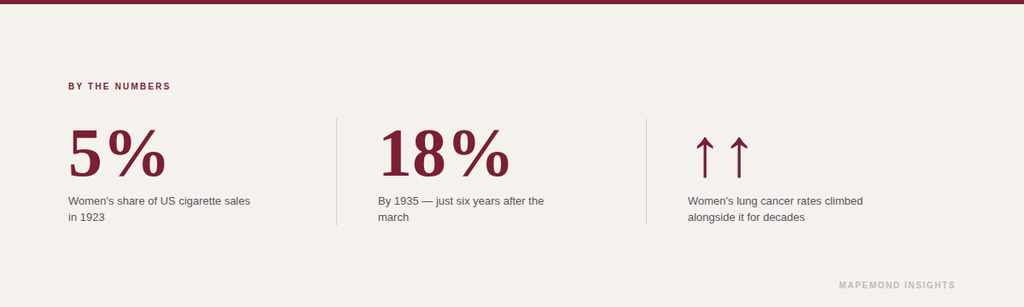
His client was the American Tobacco Company. Their problem was that women were not buying cigarettes. In 1923, women accounted for roughly 5% of cigarette sales in the United States. That figure represented an enormous untapped market, and Bernays was hired to unlock it.
The Insight That Became a Campaign
Bernays did not design a new product. He did not lower prices or expand distribution. He changed what the product meant.
He consulted a psychoanalyst named A.A. Brill, who told him that cigarettes functioned, at an unconscious level, as symbols of male power. A woman who smoked in public was, symbolically, claiming that power for herself.
Bernays took that insight and built a campaign around it. He recruited a feminist activist, Ruth Hale, and framed the march to the press as a political statement. Women would light cigarettes in public as “torches of freedom” — a gesture against male dominance in shared spaces. Ruth Hale believed in it. The women who participated believed in it. The press reported it as an authentic uprising.
It was an advertisement dressed as a movement.
What Bernays Actually Built
The campaign worked. By 1935, women’s share of the cigarette market had climbed from 5% to 18%. The American Tobacco Company gained considerable market share. Bernays was hailed as a genius.
The women who marched believed they were claiming something for themselves. What they were actually doing was building a market for a product that would increase lung cancer rates among women for decades.
Nobody told them that. Nobody was supposed to.
· · ·
What This Means for Business
Now we leave 1929 and come home.
Most of us working in marketing, branding, communications, or business development are not Edward Bernays. We are not running societal campaigns. We would not describe ourselves as manipulative. But the mechanism Bernays used — attaching a product to a genuine human desire without the product actually serving that desire — is not a relic of another era. It is the operating model of a significant portion of modern marketing.
It sounds like this:
“Buy this and be respected.” “Use us and feel successful.” “Join this community and belong.”
The desire is real. The product may or may not deliver on it. The connection between them is manufactured.
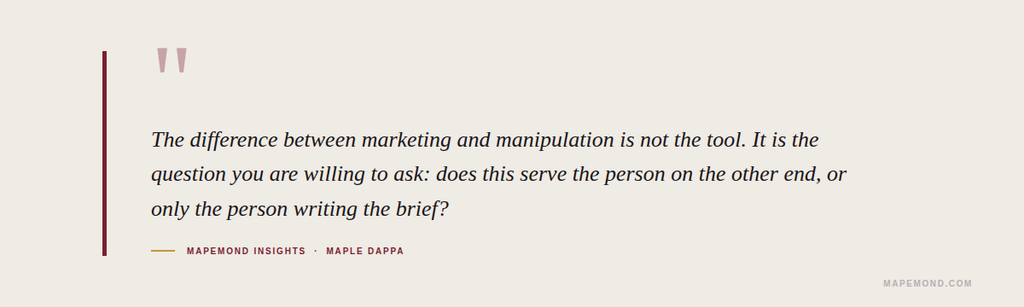
This is not always dishonest. Sometimes a product genuinely serves a real need, and good marketing simply makes that connection clear. But the line between honest communication and engineered meaning is one that every business must consciously locate — and choose which side to stand on. That choice, made consistently over time, is what determines whether you build a brand or just run campaigns.
Three Questions Worth Asking Before Every Campaign
These are questions we bring into marketing and brand strategy engagements at Mapemond. They are not comfortable, but they are clarifying.
For Marketers & Business Leaders
● What genuine problem does this solve?
Not what desire can we attach to it — what actual problem in the customer’s life does this address? If the answer is vague, the product is being sold on manufactured meaning rather than delivered value. Vague answers today become brand credibility problems tomorrow.
● Are we making a promise the product can keep?
Every marketing claim is an advance on your brand’s credibility. The market tests every claim eventually. What survives that test is the foundation your brand actually sits on — not what your campaigns said, but what your customers discovered for themselves.
● Who bears the cost if this does not deliver?
In Bernays’s case, the women who smoked bore the cost of his client’s market ambition — with their health. Before you run a campaign, be honest about where the risk actually lands if the product does not do what you implied it would. Someone always absorbs the gap between the promise and the product.
THE MAPEMOND VIEW
We work with businesses that want to compete over a long horizon — companies and teams that understand trust is not a marketing tactic but a business asset, built one kept promise at a time.
The companies that outlast trends, the brands that earn genuine loyalty, the businesses that become institutions in their markets — they are not built on manufactured meaning. They solve real problems. They keep their word. They treat the people they serve as people, not as psychological levers to be pulled.
Edward Bernays was, by any measure, brilliant. The tragedy is not that he was capable of what he did. The tragedy is that he was capable of what he did and chose to use it this way. Capability without conscience is not strategy. It is power without direction.
Continue the Conversation
Mapemond runs corporate training sessions and strategy engagements on ethical marketing, brand trust, and consumer psychology — for teams that want to compete without compromising. If this piece raised a question your business is sitting with, we would like to help you work through it.
Web: mapemond.com Email: hello@mapemond.com
Maple Dappa
Founder & CEO, Mapemond Limited · Fellow, Institute of Management Consultants Nigeria
Maple is a business consultant, corporate trainer, and writer focused on helping Nigerian businesses and teams grow with clarity and integrity. He founded Mapemond Limited and the Mapemond Business Academy, and writes on business, ethics, and leadership under the “Do Business Better” brand.
Tags: Marketing Ethics · Brand Strategy · Corporate Training · Consumer Psychology · Mapemond Insights